















Game facts
| Field | Detail |
|---|---|
| Provider | Pragmatic Play |
| Game format | Cluster-paying candy grid |
| Main feature | Multiplier positions on the grid |
| Provider-page RTP | 96.50% (provider page) |
| Demo currency | Virtual EUR; not an NZD casino balance |
| Demo edition | Sugar Rush |
The figures and mechanics above refer to the provider’s exact product page, checked on 12 November 2026. They do not identify the configuration inside every casino account.
How the game pays
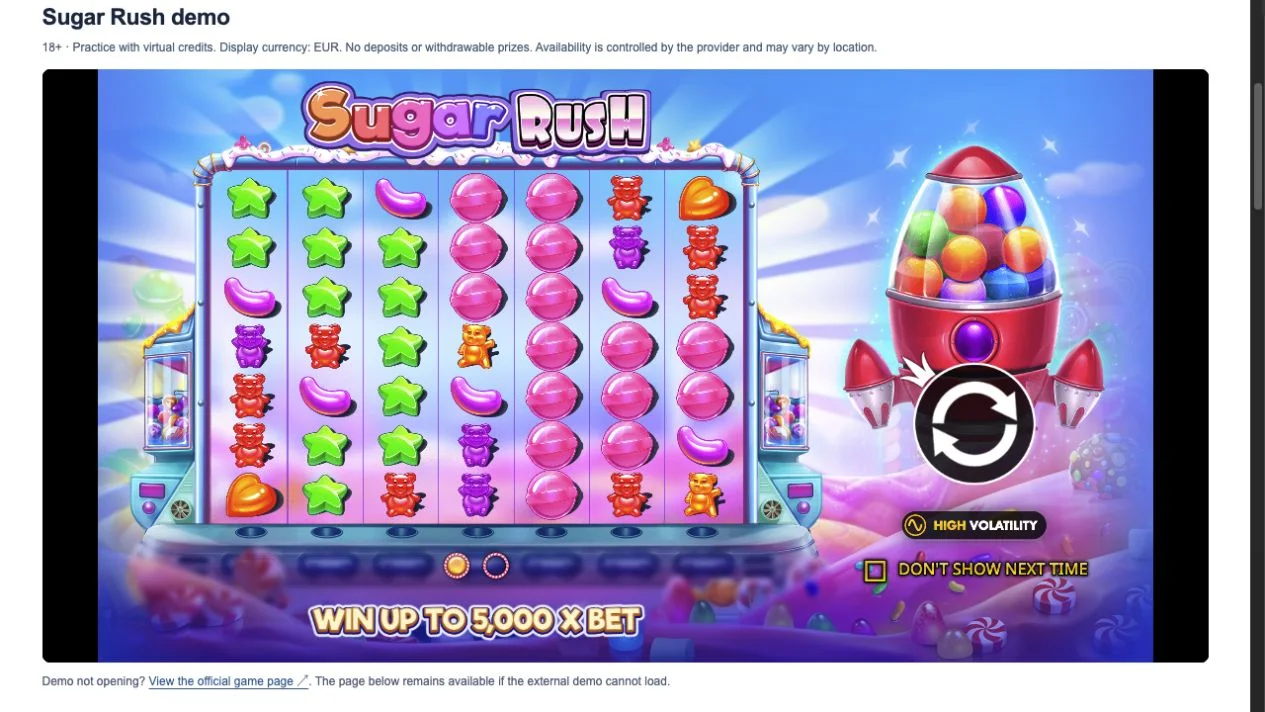
A qualifying cluster contains at least five matching symbols joined under the game’s adjacency rules. Winning symbols disappear and new symbols fall into place. Unlike a pay-anywhere game, matching symbols spread across unrelated positions are not automatically one paying cluster.
Multiplier positions on the grid
Winning positions become marked. Further qualifying wins at those positions can build multipliers, starting at 2x and doubling within the stated ladder. The provider describes a maximum position multiplier of 128x in this original edition. Free spins use their own persistence rules, which should be read separately from an ordinary base-game round.
What to watch in the demo
- Follow one marked position through successive tumbles to understand the mechanism.
- A coloured square is a stored feature state, not a payment by itself: it still needs the relevant winning symbols.
- The number of marked positions therefore should not be read as a guarantee of a profitable next spin.
RTP and outcome variation
Pragmatic Play’s product page publishes 96.50% RTP. On an illustrative NZ$100 of total stakes, that rate gives a theoretical expected loss of NZ$3.50: NZ$100 × (1 − 96.50 / 100). This is a turnover example, not a forecast for a NZ$100 deposit. A short session can lose the full balance or produce a very different result.
For turnover, house edge and session variation, use the RTP calculator and explanation.
Compare related games
| Game | Paying system | Feature |
|---|---|---|
| Sugar Rush | Cluster-paying candy grid | Multiplier positions on the grid |
| Sugar Rush 1000 | 7×7 cluster-paying grid | The upgraded position-multiplier ladder |
| Fruit Party 2 | Cluster pays with progressive multiplier wilds | Wild growth across tumbles |
Demo questions
Does a marked square pay on its own?
No. A marked multiplier position needs the relevant qualifying win. The square records feature state rather than an independent prize.
How does Sugar Rush compare with its related games?
Sugar Rush 1000 has a different multiplier scale and identifier. Its figures should not replace the rules of the original demo.
Sources & scope
Sources checked on 12 November 2026. Operator/provider statements remain attributed claims; no financial transactions were performed.
Prepared with AI assistance. How we work · Corrections